Updated: Jul 6

As part of the research project Agrithes (Rural Heritage and the Architecture of Food Production—The Case of Thessaly. Hellenic Foundation for Research and Innovation (ELIDEK) 2024–27), the Dept. of Architecture of the University of Thessaly hosted the international seminar with the title “The Agrarian-Urban Project in Thessaly” on November 4–6, 2025, with the participation of researchers from the Department of Civil, Construction, and Environmental Engineering (DICEA), and the Department of Land, Environment, Agriculture and Forestry (TESAF) of the University of Padua, and speakers from the Department of Architecture of the University of Thessaly, Greek academics, and researchers from the AGRITHES team.
The conference served as an initial step in researching the agrarian landscape of the Thessalian Plain, drawing comparisons with similar studies conducted in the Veneto region. Academics and researchers from Greece and Italy examined the two geographical contexts and their historical evolution since the early 20th century, when national agrarian reforms were implemented, leading to significant changes in production, landscapes, and daily life.
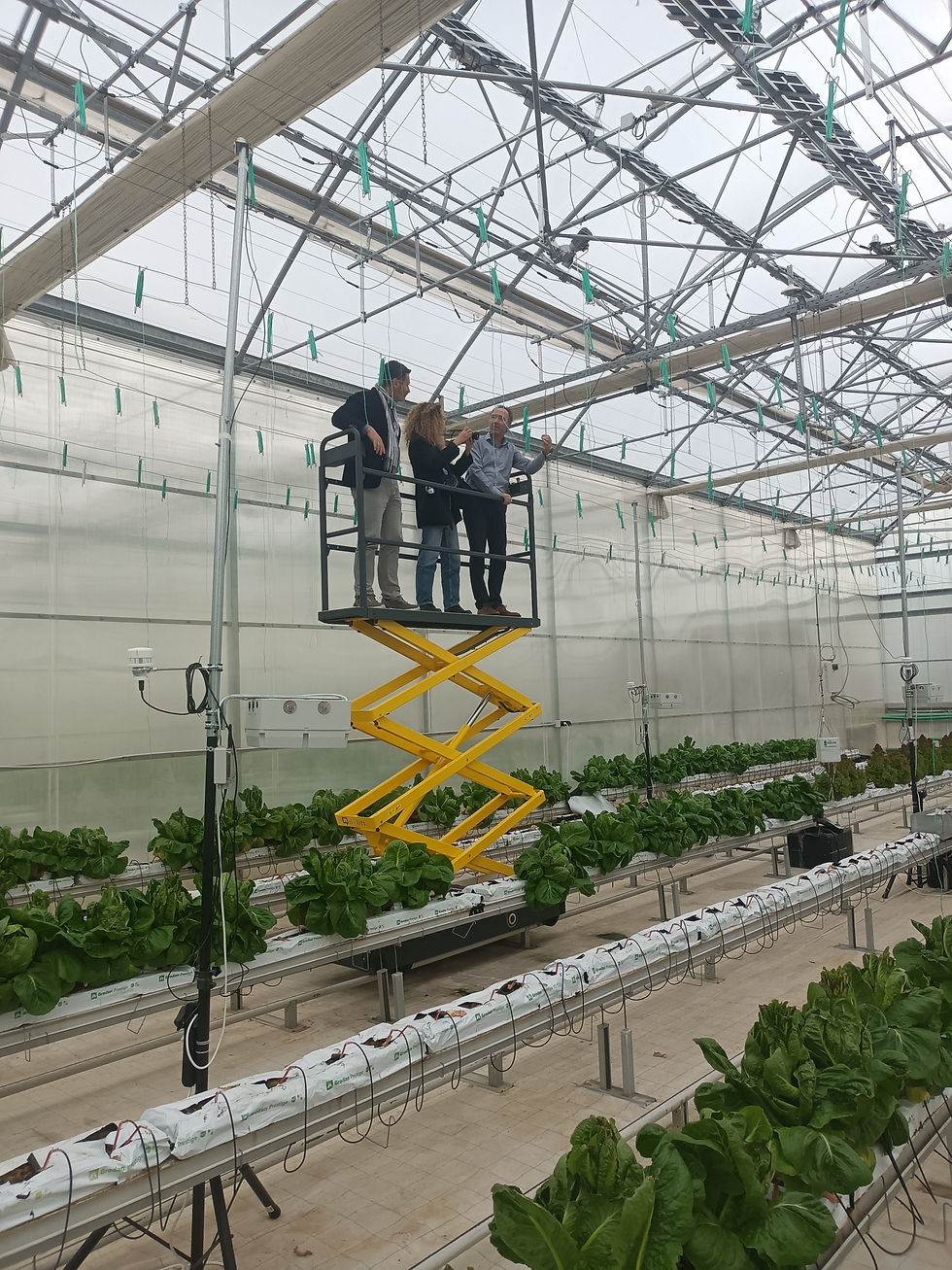
Visit at the UTh Greenhouses in Velestino, Magnesia
On Tuesday 4h, the AGRITHES team and professor from the DICEA of the Universty of Padova visited the UTh Greenhouse Park and Experimental Farm in Velestino. AGRITHES expert Prof. Konstantinos Kittas and prof. Nikolaos Katsoulas, both from the Department of Agriculture, Crop Production and Rural Environment of the UTh guided us thoughtout the visit. The greenhouse serves as a major hub for agricultural education, research, and sustainable farming innovations. The site is a primary testing ground for European agricultural projects—including agrivoltaics, eco-friendly nutrient management, and low-input cultivation.


Conference Day
On Wednesday the 5th, we convened at the TAM, University of Thessaly, for an intensive day of discussion and critical exchange. The primary objective of the session was to establish a research framework for investigating the urbanization of the Thessalian countryside through the theoretical lenses of the diffuse city and planetary urbanization. The Veneto Region represents one of the most significant European case studies in regional urban development. It is characterized by an extensive polycentric, low-density urbanized territory lacking a single dominant metropolitan center, where residential settlements, small- and medium-sized industrial activities, and agricultural land are distributed in a relatively homogeneous pattern across the landscape. Drawing a parallel between the spatial development trajectories of Veneto and the Thessaly Region provides a productive analytical framework for situating the agrarian landscape of Thessaly within broader debates on the urbanization of the countryside. This comparative perspective enables an examination of the transformations of rural territories beyond conventional urban–rural dichotomies, highlighting the emergence of dispersed urbanization processes within predominantly agricultural landscapes.

Session 1 | Features of Città Diffusa
Francesco Mauro, UNIPD, The Diffuse City of Central Veneto, nowadays
Catherine Dezio, UNIPD (online), Beyond the City: Agricultural Landscapes in Veneto between Diffuse Urbanization, Fragile Communities, and Climate Challenges
Alessandro Bove, UNIPD, Land reclamation in the lowlands: experiences of territorial organisation construction in Veneto (Italy) between the first and second post-war periods
The presentations examined the contemporary transformation of the Veneto Region, addressing the interplay between diffuse urbanization, agricultural landscapes, and large-scale territorial interventions. Together, they offered a comprehensive perspective on the historical and ongoing processes that have shaped one of Europe's most emblematic examples of dispersed regional urbanization.
Francesco Mauro explored the current condition of the diffuse city in Central Veneto, examining how decades of decentralized urban growth have produced a polycentric territorial structure in which settlements, productive activities, infrastructure, and agricultural land are closely interwoven. His presentation highlighted the spatial and social implications of this urban form, discussing the challenges it poses for regional planning and territorial governance.
Catherine Dezio shifted the focus to the agricultural landscapes of Veneto, investigating their transformation under the combined pressures of diffuse urbanization, demographic change, and climate crisis. Her contribution emphasized the increasing fragility of rural communities and productive landscapes, arguing that contemporary agricultural territories should be understood as dynamic spaces where environmental, social, and urban processes converge. The presentation underscored the need for integrated approaches capable of addressing the resilience of both landscapes and communities.
Alessandro Bove examined the historical construction of the Veneto lowlands through land reclamation projects carried out between the First and Second World Wars and in the subsequent post-war period. His presentation illustrated how hydraulic engineering, agricultural modernization, and state-led territorial policies fundamentally reorganized the region, transforming wetlands into productive agricultural landscapes while establishing new patterns of settlement, infrastructure, and territorial management. These interventions were presented as foundational processes in the long-term construction of the Veneto landscape and its subsequent urbanization.


Session 2 | The Agrarian Urban Landscape in Greece
Vilma Hastaoglοu, AUTh (online), The emergence of a modern agro-techical landscape: Rural refugee settlement in Northern Greece, 1923-1930
Thymios Dimopoulos, UA (online), Mapping change in the agricultural landscape of Lemnos
Costis Hadjimichalis, HUA, Imagining rurality and the key role of land and water
The speakers approached the transformation of the Greek countryside from complementary historical, spatial, and political perspectives, collectively highlighting the processes through which rural landscapes have been shaped, represented, and reconfigured over time.
Vilma Hastaoglou examined the emergence of a modern agro-technical landscape in Northern Greece through the establishment of rural refugee settlements between 1923 and 1930. Her presentation explored how state-led resettlement policies, agricultural modernization, and territorial planning contributed to the production of new rural environments, emphasizing the relationship between settlement patterns, infrastructure, and agricultural development.
Thymios Dimopoulos focused on the agricultural landscape of Lemnos, presenting cartographic and spatial methodologies for documenting landscape change. By mapping transformations in land use, cultivation patterns, and rural morphology, his contribution demonstrated how historical and contemporary spatial analysis can reveal the evolving organization of agricultural territories and the dynamics that have reshaped them over time.
Costis Hadjimichalis addressed the conceptual and political dimensions of rurality, arguing for a critical reconsideration of the ways in which rural spaces are imagined and governed. His presentation underscored the central role of land and water as fundamental resources in the production of rural landscapes, highlighting how questions of ownership, access, environmental management, and territorial governance are inseparable from broader socio-economic and political processes. Taken together, the presentations offered a multidimensional understanding of the Greek countryside, combining historical inquiry, spatial analysis, and critical territorial theory to examine the changing relationships between agricultural production, settlement, landscape, and rural governance.
Session 3 | Is the Thessalian Plain a Diffuse City?
Kostas Manolidis, UTh, The Wonder of the Flat Land
Maria Stamatellou, UTh – AGRITHES, Settlement in the Thessalian Plain, through Magoules and Konakia
Dimitris Poulios, UTh – AGRITHES, Constructing the Thessalian Plain: Land Reform and the Urbanization of the Countryside
The presentations explored the historical and spatial formation of the Thessalian Plain, examining how its landscape has been shaped through the interaction of environmental conditions, settlement patterns, and socio-political transformations.
Kostas Manolidis reflected on the distinctive character of the Thessalian Plain, presenting its vast flat landscape as both a geographical condition and a cultural construct. His contribution emphasized how the morphology of the plain has influenced patterns of habitation, agricultural production, and territorial perception, highlighting the reciprocal relationship between landscape and human occupation.
Maria Stamatellou examined the historical development of settlement in the Thessalian Plain through the study of magoules and konakia. By tracing the continuity and transformation of these settlement forms, her presentation illustrated the long-term evolution of human occupation in the region, revealing how environmental adaptation, agricultural practices, and social organization have contributed to the construction of the rural landscape.
Dimitris Poulios focused on the role of land reform in reshaping the Thessalian countryside during the twentieth century. His presentation investigated how land redistribution, new settlement policies, and agricultural modernization transformed both the spatial organization of the plain and its patterns of habitation. Framing these processes within the broader concept of the urbanization of the countryside, he argued that the Thessalian Plain should be understood as a territory where rural and urban dynamics have become increasingly intertwined through the reconfiguration of productive landscapes, infrastructure, and settlements. Collectively, the presentations offered complementary perspectives on the historical production of the Thessalian Plain, demonstrating how geography, settlement, and institutional interventions have jointly shaped its landscape while providing a foundation for interpreting its contemporary transformations.

Session 4 | Roundtable
Fabiano Micocci, Dimitris Poulios, Maria Stamatellou, Vaso Trova, Konstantinos Kittas, Evangelia Bosmi, Angelo Bertolazzi, Francesco Mauro, Luigi Siviero, Alessandro Bove, Angelo Bertolazzi, Kostas Manolidis, Vilma Hastaoglοu, Costis Hadjimichalis, Metaxia Markaki


